
Lipreading can be an important part of communication for people who are deaf or hard of hearing, but even experienced lipreaders cannot see everything that is being said.
Many speech sounds look identical or very similar on the lips. Some information can be particularly difficult to distinguish visually. Numbers are a good example: a small difference can change a time, date, price, dosage or reference number completely.
Background noise, poor lighting, distance, unfamiliar speakers, accents, people turning away and several people speaking can all add to the demands of lipreading.
This is where professional communication support can help.
There are several types of communication support available for lipreaders, including lipspeakers, Lipspeaking with Sign, speech-to-text reporting, electronic notetaking and remote captioning.
There is no single option that is right for every lipreader. The right communication support depends on the individual, the environment and the type of communication taking place.
Lipspeakers and Lipspeaking
A lipspeaker is a communication professional who is professionally trained to be easy to lipread.
During lipspeaking, the lipspeaker listens to the person speaking and silently and accurately reproduces their message using clear lip patterns. They reproduce the rhythm and flow of the original speaker and use facial expression, gesture and other visual information where appropriate.
This allows the lipreader to concentrate on one consistently visible and professionally trained person rather than trying to follow different speakers around a room.
Lipspeaking can be particularly valuable when someone wants visual access to communication while retaining the natural interaction and flow of a spoken conversation.
Lipspeakers work in a wide range of settings, including workplace meetings, training, healthcare appointments, conferences, education, interviews and public services.
Signed Lipspeaking
Some lipreaders use sign language alongside lipreading. For these individuals, Lipspeaking with Sign may provide an appropriate form of communication access.
Signed Lipspeaking, also known as Lipspeaking with Sign, combines clear lip patterns with signs, providing additional visual information alongside the spoken message.
It may be used by lipreaders who use some sign language but do not necessarily require communication entirely through British Sign Language (BSL).
As with all communication support, the amount and type of sign used should reflect the communication needs of the individual.
Speech-to-Text Reporting
A speech-to-text reporter, often referred to as an STTR, converts speech into text in real time.
Using specialist equipment, the reporter produces a highly accurate, near-verbatim record of what is being said. The text can be displayed on a laptop, tablet or screen for the deaf or hard of hearing person to read.
Speech-to-text reporting can be particularly useful when detailed and accurate access to spoken information is important, including conferences, meetings, education and formal proceedings.
For some lipreaders, having speech converted directly into text can remove some of the uncertainty that comes with relying on lipreading alone.
Electronic Notetaking
Lipreading requires concentration.
Trying to lipread while simultaneously looking down to write notes can mean missing what is being said. This can be particularly challenging during lectures, meetings and training where large amounts of information need to be recorded.
An electronic notetaker allows the lipreader to concentrate on the speaker and the conversation while a trained professional produces written notes.
Unlike speech-to-text reporting, electronic notetaking is generally intended to capture the important information and meaning rather than provide a verbatim transcript.
It can be particularly useful in lectures, training sessions, meetings and other situations where the person needs an accessible record of the information afterwards.
Remote Captioning
Communication support for lipreaders does not always need to be provided by someone in the same room.
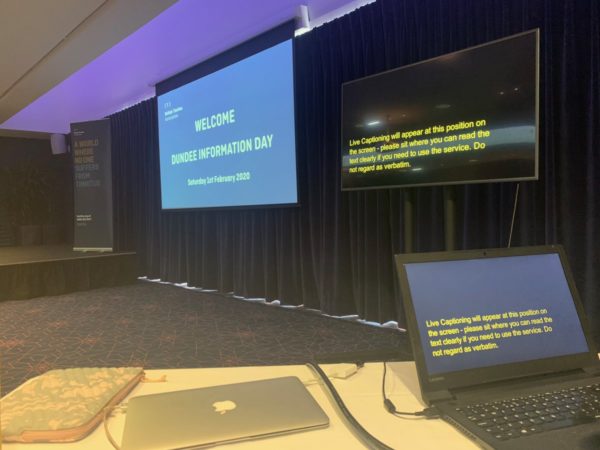
Remote captioning provides live text access while the professional providing the captions works remotely. Audio from the meeting, event or conversation is transmitted to them and the resulting text is displayed for the person using the service.
Remote captioning can provide additional flexibility for online and hybrid meetings and may also be used in some face-to-face environments.
The suitability of remote captioning will depend on the setting, technology, audio quality and the communication needs of the person using it.
Lipreading and Sign Language Are Not Always Either/Or
Not all deaf people use sign language, and not all deaf people lipread. But these are not necessarily separate groups.
Some people who use British Sign Language (BSL) also lipread, just as some people who rely predominantly on lipreading may use some sign language. People may draw on different communication methods in different situations, and their level and type of language use can vary considerably.
It is also important to distinguish between language need and communication preference.
For someone whose first or preferred language is BSL, access to BSL may be a language requirement rather than simply a choice between different forms of communication support. A lipspeaker, captions or written English are not substitutes for a BSL interpreter when access in BSL is what the person needs.
Equally, a deaf person who communicates primarily through spoken English should not be assumed to use or understand BSL simply because they are deaf.
The starting point should always be the individual: what language do they use, how do they communicate, and what communication access do they need in this particular situation?